Category: Uncategorized

Foundations of Field Leadership Online: Registration Opening February 10th for Spring Courses!

Courses begin April 16, 2026

If you want to fast-track your new and aspiring field leaders, MCAA has just the program! Once a week for 8 weeks, FFL students spend 90 minutes online with an experienced field leader, who will walk them through best practices and practical strategies of running work and running a crew. From Planning to Leadership, from Documentation to Safety: our instructors break down the ‘why’ and the ‘how’ of things that every foreman must understand to be successful.

Foundations of Field Leadership (FFL) is taught by senior field leaders with extensive experience running mechanical jobs. The program is based on the input of 42 mechanical field leaders from MCAA member companies across the country. The topics covered in this course were identified by these 42 experts as being the most important things for new field leaders to learn.

Each lecture is a combination of best practices, lessons learned, and tips and tricks provided by the field leaders themselves – based on their experience and leveraging their extensive knowledge of the role of a field leader. The course is made up of weekly online lectures with real-time student interaction, quizzes, and short video assignments.

We have currently had over 500 students graduate from past FFL courses, and we look forward to welcoming more during the next round of classes. Here are a few comments from our past FFL grads on their weekly classes:

  • “Very easy to listen to the instructor, very knowledgeable and personable.”
  • “I like learning from someone with a lot of experience and learning how to do the job more efficiently.”
  • “I appreciated [the instructor’s] content. I’ve been in the trade for 25 years and have only been running work for the last 3 years. I’ve either been in or around all the situations [the instructor] spoke about today and appreciated his insight. Great ways to handle things.”
  • “The information was delivered clearly and was easy to understand. It gave everyone the chance to apply their thoughts and comments.”
  • “[I appreciated the instructor] acknowledging the fact that being in this class is a step forward in my career, and it feels good to know my hard work and dedication hasn’t gone unnoticed by my company.”

Registration opens February 10th for our next round of classes, which begin April 16th. There is no limit on how many new or potential field leaders an MCAA member can enroll, but registration will be done on a first-come, first-served basis. Additional classes may be offered based on demand.

Visit the FFL course webpage to learn more about this exciting opportunity for new and future field leaders, and to sign your people up today!

MCAA Government Affairs Update for the Week of January 26, 2026: The Latest Developments Impacting Our Industry

As part of its ongoing commitment to protecting your livelihood and setting the stage for a bright future, MCAA has secured the services of Longbow Public Policy Group to advise our MCAA Government Affairs Committee (GAC). GAC Chair, Jim Gaffney will be passing along information relative to our industry on a regular basis.

On Monday, January 26, 2026 MCAA Lobbying Firm, Longbow Public Policy Group provided the following information:

Trump Administration

  • The Pipeline and Hazardous Materials Safety Administration (PHMSA) issued an advisory bulletin in response to the March 2023 natural gas pipeline explosion in West Reading, Pennsylvania that killed seven people and injured ten others. The advisory follows National Transportation Safety Board (NTSB) findings that the incident involved plastic Aldyl A service tees with Delrin inserts and reflects NTSB recommendations that PHMSA strengthen guidance under the Distribution Integrity Management Program (DIMP). In the bulletin, PHMSA urges natural gas distribution operators to inventory plastic pipe and components exposed to elevated temperatures, evaluate risks of degradation and failure, and implement mitigation measures—including leak management, remediation, or replacement—where necessary. PHMSA also advises operators to ensure that new or replacement plastic pipelines are installed with adequate clearance or insulation from heat sources to prevent premature degradation and improve overall pipeline safety.
  • Last Thursday, the Trump Administration ordered a review of federal funding to 14 Democratic-led states and Washington, D.C., escalating its campaign to pressure jurisdictions that oppose or fail to assist with federal immigration enforcement efforts. A memorandum from the Office of Management and Budget directs nearly all federal agencies to inventory funding provided to California, Colorado, Connecticut, Delaware, Illinois, Massachusetts, Minnesota, New York, New Jersey, Oregon, Rhode Island, Vermont, Virginia, Washington, and Washington, D.C. MCAA’s advocacy team is closely watching what comes out of this review and if it could lead to freezing some states’ allotments under federally funded programs that create work for MCAA members. Pursuant to the OMB directive, departments and agencies are busy inventorying both current and anticipated fiscal year 2026 obligations to the targeted states. We are cautioning against any disruption of federal funds for EPA Water Infrastructure Finance and Innovation Act (WIFIA) loans, EPA Clean Water and Drinking Water State Revolving Funds, Army Corps of Engineers civil works projects, certain DOT formula and discretionary grants, and DOE grid and energy infrastructure funding critical to data centers.
  • Last week, White House chief of staff Susie Wiles said that this week President Trump will begin regular trips across the country to rally voters ahead of the 2026 midterm elections. His first stop will be Iowa, where he will deliver a speech focused on the economy and energy, as the White House moves to highlight the President’s work on domestic issues and affordability. New polling out this week shows some public dissatisfaction a year into the President’s second term. The White House says some media outlets are only emphasizing negative polling data about the President and his policies and are questioning the integrity of some of the negative polling. Last Thursday, the President threatened to sue the New York Times over a poll it released with Sienna College indicating that the coalition that got him elected in 2024 is fraying.
  • As part of the White House’s increasing focus on housing affordability issues ahead of the November midterms, last week as President Trump floated the idea of allowing ordinary homeowners to take an annual depreciation deduction on their personal residences to recover certain property costs over a set period of time, noting that when a “corporation buys a house, they get depreciation.” This followed President Trump signing an executive order last Tuesday barring “institutional investors” from owning “single family homes.” Under the order, the Treasury Department has 30 days to develop “definitions of ‘large institutional investor’ and ‘single-family home.’” Within 60 days, the Agriculture Department, the Department of Housing and Urban Development, the Department of Veterans Affairs, the General Services Administration, and the Federal Housing Finance Agency are required to issue guidance ensuring that they are not “providing for, approving, insuring, guaranteeing, securitizing, or facilitating the acquisition” of single family homes by large institutional investors. This guidance must include “exceptions for build-to-rent properties that are planned, permitted, financed, and constructed as rental communities, and such other appropriate, narrowly tailored exceptions as the applicable agency may determine appropriate to further the policies of [the] Administration.” The Justice Department and the Federal Trade Commission are directed to review acquisitions by large institutional investors for anti-competitive practices and prioritize enforcement against such practices by institutional investors in the single-family home rental market. A fact sheet on the order is available here.
  • MCAA continues to closely monitor tariff developments impacting MCAA members, including the pending Supreme Court decision on the scope of the President’s tariff authorities. The U.S. Supreme Court still has not issued a decision in the closely watched case over President Trump’s tariff authority under the International Emergency Economic Powers Act that was used to implement his “Liberation Day” tariffs. With the justices heading into a four-week recess, the next likely decision day is February 20th. This leaves MCAA and other groups interested in the tariff policy navigating uncertainty over the administration’s tariff powers and plans.
  • The MCAA policy team also continues to monitor implementation of the One Big Beautiful Bill Act (OBBBA), including the “No Tax on Overtime” provision of the law that we discussed at the Industry Funds Conference last month. Last Friday, the Internal Revenue Service (IRS) released a new Fact Sheet with questions and answers about this deduction. Only two of the questions and answers in the fact sheet cover information that is not in the MCAA policy team’s recently-posted explanation of the deduction. First, question #2 addresses how to ascertain if an employee is exempt from overtime under the Fair Labor Standards Act (FLSA), such that they are ineligible for the deduction. Second, question #7 provides guidance to aid employees who are eligible for the deduction in determining the amount of their deduction for qualified overtime compensation.

Congress

  • As Congress races to avoid a partial government shutdown this Friday, January 30th, the House last Thursday voted 341–88 to pass a minibus appropriations package that includes the fiscal year (FY) 2026 Labor-HHS-Education and Transportation-HUD spending bills. The Labor-HHS-Education bill cuts $5 million from the National Labor Relations Board, marking the agency’s first funding reduction in more than a decade. The bill provides $13.7 billion for the Department of Labor, an increase of $65 million over FY 2025 and roughly $4 billion above the President’s request. It includes: (1) level funding for the Wage and Hour Division for enforcement activities; (2) a $3 million funding cut for the Occupational Safety and Health Administration; (3) level funding for the Employee Benefits Security Administration, which oversees ERISA-governed retirement and health plans; (4) $285 million for Registered Apprenticeships; (5) $2.9 billion for Workforce Innovation and Opportunity Act formula grants; and (6) $1.45 billion for Career and Technical Education grants. Notably, the bill continues funding for the Office of Federal Contract Compliance Programs ($100 million) and the Women’s Bureau ($23 million), both of which the Trump Administration proposed eliminating. The measure also includes bipartisan health provisions targeting pharmacy benefit managers (PBMs) by expanding transparency requirements and mandating the pass-through of drug savings to health plans. Separately, the Transportation-HUD bill provides funding for the Pipeline and Hazardous Materials Safety Administration (PHMSA), including $214.8 million for pipeline safety programs. This includes dedicated funding for state one-call grants, LNG safety oversight, underground natural gas storage safety, emergency preparedness grants, and pipeline safety information grants for communities. The bill also: (1) prohibits the Department of Transportation from withdrawing, terminating, or rescinding previously approved funding without notifying House and Senate appropriators within three days; (2) provides $35 million for small shipyards; and (3) appropriates $103.3 million for port infrastructure accounts at the Maritime Administration. The Senate is expected to consider the package when it returns to session this week.
  • As Congress acknowledges the growing backlash to the rapid expansion of data centers that the MCAA advocacy team is confronting as its advocates for permitting reform, an investigation launched by Sens. Elizabeth Warren (D-MA), Chris Van Hollen (D-MD), and Richard Blumenthal (D-CT) into how much data centers are driving up Americans’ electric bills has data center developers playing defense. Last Thursday, the Senators announced that the nation’s largest data center developers—including Google, Amazon, Microsoft, Meta, Equinix, CoreWeave, and Digital Realty—have made new commitments to “pay their fair share” of electricity and grid infrastructure costs. In written responses, Google said it is “paying for 100 percent of the electricity” it uses and ensuring that “Google, not local residents, pays for any new grid infrastructure required for our growth.” Equinix emphasized that large energy users “pay a premium for what they’re utilizing so that we don’t impact small ratepayers,” often through long-term, take-or-pay utility agreements designed to insulate other customers from financial risk. At the same time, the companies stressed that many power supply agreements remain confidential, with Google noting that pricing terms are “for the most part confidential” despite being subject to regulatory review. The Democratic Senators feel this limits public transparency. Sen. Van Hollen said he is not satisfied with the companies’ responses and plans to press forward with legislation that would require data centers to fully cover the cost of the electricity they consume, signaling that further scrutiny could shape the pace and structure of future data center development.
  • The importance of the MCAA’s advocacy on permitting reform to the construction of AI data centers, related power generation, and other infrastructure was highlighted last week in new construction and financing data showing that spending on data center construction is projected to rise by roughly 23% in 2026. Data centers are expected to account for more than 6% of all nonresidential construction spending in 2026, up from about 2% in 2023. Much of this growth is concentrated in the states served by grid operator PJM Interconnection, where large load demand from data centers is outpacing the ability to bring new generation and transmission online using current permitting processes. PJM has warned that existing infrastructure cannot support projected load growth and has proposed the “immediate initiation” of backstop reliability measures, including faster—but more restrictive—data center interconnections, enhanced demand forecasting requirements, and new rules requiring large power users to either bring their own generation online or accept early curtailment during periods of system stress. PJM acknowledges these steps are not a long-term solution, but rather a stopgap driven by delays in permitting and building new generation and transmission capacity. The Trump Energy Department is trying to provide loans and other funding for this generation and transmission capacity. For example, last Thursday, the Department of Energy’s Office of Energy Dominance Financing (EDF) said that its federal loan authority is being refocused to support AI-driven load growth and grid reliability. EDF plans to deploy its $289 billion loan authority to back energy and manufacturing projects that “meaningfully contribute to U.S. energy security, grid reliability, and lowering costs,” explicitly tying federal financing decisions to maintaining U.S. leadership in emerging AI technologies. To align with that goal, EDF announced it is restructuring, revising, or eliminating more than $83 billion in Biden-era loans and conditional commitments, de-obligating nearly $30 billion, and redirecting the funding toward dispatchable generation, grid and transmission capacity, and domestic manufacturing. EDF said it will prioritize financing for nuclear, natural gas, geothermal, grid and transmission, and manufacturing projects, while eliminating roughly $9.5 billion in prior wind and solar commitments and redirecting that funding toward other power sources. Taken together, the Administration’s effort to redirect federal loan authority toward AI-supporting energy infrastructure and PJM’s move toward curtailment and self-supply requirements underscore why the MCAA’s advocacy on permitting reform has become increasingly important.
  • MCAA health plan trustees may be interested in last Thursday’s contentious hearing at which health insurance executives faced sharp, bipartisan criticism from the House Energy and Commerce Health Subcommittee over soaring premiums, executive compensation, and opaque pricing practices. Subcommittee Chairman Morgan Griffith (R-VA) argued that “Obamacare coverage is not translating to patient or taxpayer affordability,” while Rep. Brett Guthrie (R-KY) highlighted Congressional Budget Office projections of premium increases between 4–8% after the subsidies expired at the end of last year as insurers in many markets sought rate hikes of 30–50% in 2026. Rep. Buddy Carter (R-GA) pressed CVS Health CEO David Joyner on executive compensation, and Rep. Nanette Barragan (D-CA) warned that stock-based compensation is prompting insurers to prioritize shareholders over patients. Lawmakers also focused on consolidation and pharmacy benefit manager (PBM) practices, with Rep. John Joyce (R-PA) criticizing ACA medical loss ratio rules for creating “perverse incentives,” and Rep. Mariannette Miller-Meeks (R-IA) questioning whether PBM rebates are passed through to patients. Insurers countered that premiums are a “symptom, not a cause” of rising healthcare costs, citing higher hospital, physician, and drug prices, with UnitedHealth Group CEO Stephen Hemsley pledging to return any profits from ACA marketplace plans in 2026. The testimony came amid mounting political pressure from President Trump, who has publicly attacked insurers and called for price cuts, setting the stage for further scrutiny.
  • Relatedly, as Congress continues to debate reforms to pharmacy benefit managers (PBMs), last Wednesday, the House Judiciary Committee released an interim staff report stemming from its 2024 investigation into whether major PBMs use their market power to choke off new competition. The report concludes that CVS Health’s PBM—CVS Caremark—may have engaged in exclusionary conduct that raises serious antitrust concerns. The report focuses on CVS’s response to “hub” pharmacy companies—digital platforms (e.g., BlinkRx and others) that partner with independent pharmacies to provide services like real-time price checks, benefit verification, and streamlined prescription fulfillment—arguing that CVS viewed these hubs as a disruptive threat and responded by pressuring independent pharmacies to sever ties rather than competing on the merits. According to internal documents reviewed by the Committee, CVS allegedly: (1) monitored independent pharmacies for hub-related activity; (2) rewrote its provider manual to restrict or deter hub relationships; (3) used the rule changes as a pretext to launch audits; and (4) issued cease-and-desist letters threatening network termination—a powerful tool given CVS Caremark’s broad pharmacy network reach and large PBM market share. The Committee report says that CVS publicly justified its actions as anti-fraud measures driven by plan sponsor concerns, but did not produce evidence tying legitimate hub relationships to fraud and later quietly backtracked, sending letters to some pharmacies allowing them to work with at least one hub (BlinkRx) and stating that such relationships would not be treated as a basis for audit findings or noncompliance. The report argues CVS’s conduct may fit established theories of unlawful monopoly maintenance under the Sherman Act and warrants the Committee pursuing legislative reforms aimed at curbing emerging PBM practices that suppress innovation and limit pharmacy and patient choice. MCAA will continue engaging to ensure any such proposals do not undermine ERISA preemption.
  • As the long-running controversy over the Trump Justice Department’s handling of the Jeffrey Epstein files continues to consume attention on Capitol Hill and distract from other priorities, last Wednesday the House Oversight Committee advanced contempt resolutions against former President Bill Clinton by a strong bipartisan vote of 34-8 and against former Secretary of State Hilary Clinton by a much narrower vote of 28-15. On a party-line vote, the Committee rejected a Democratic-sponsored amendment to hold Attorney General Bondi in contempt for failing to release the Epstein files in DOJ’s possession. If the contempt resolutions against the Clintons pass the House, the Trump Justice Department will decide whether to pursue criminal charges. The contempt resolutions came as a federal judge declined a request from Reps. Thomas Massie (R-KY) and Ro Khanna (D-CA) to appoint an independent monitor to oversee the Justice Department’s release of files related to Jeffrey Epstein, while acknowledging “legitimate concerns” about whether the department is complying with a recently enacted disclosure law. The judge said his role in the criminal case involving Ghislaine Maxwell does not give him authority to supervise the Justice Department’s disclosures but noted his ruling does not prevent lawmakers from suing.
  • In a preview of the oversight agenda Democrats might pursue if they capture a majority in the House or Senate in the coming midterm elections, House Oversight Committee Democrats released an interim staff analysis accusing President Trump and the Trump family of turning cryptocurrency ventures into a “digital kickback” system—using opaque token sales, stablecoins, and a $TRUMP memecoin to let foreign interests and other actors funnel money to the family with limited public visibility—while potentially seeking favorable treatment, access, or pardons. Alongside the report, House Oversight Ranking Member Robert Garcia (D-CA) launched a “Trump Family Digital Grift Wealth Tracker” that currently lists $2.255 billion in “digital grift profits,” $8.862 billion in total “digital grift wealth,” and $436 million in profits attributed to foreign interests.

Around the Country

  • MCAA members working on data centers, industrial facilities, and energy-intensive manufacturing projects should be aware that the Energy Department’s Office of Critical Minerals and Energy Innovation last Thursday announced the award of $155 million for 16 projects to enhance DOE National Laboratories’ capabilities to develop cross-sector technologies for improving the efficiency and competitiveness of energy-intensive industries. Projects funded under this announcement include: (1) $20 million for the Oak Ridge National Laboratory to accelerate the development and adoption of next-generation cement and concrete materials; (2) $15 million for the Sandia National Laboratories to advance a thermal energy storage testbed; (3) $10 million to National Energy Technology Laboratory to make testbed facilities for the commercial adoption of fuel-flexible combustion technologies; and (4) $6 million for Lawrence Berkeley National Laboratory to form a data center cooling testbed network to bring cooling technologies to market. The full list of projects funded under this announcement are available here.
  • MCAA members engaged in pipeline construction, repair, and integrity management work in Minnesota should be aware that last Thursday, the Pipeline and Hazardous Materials Safety Administration (PHMSA) issued a Corrective Action Order to Northern Natural Gas Company following a rupture impacting approximately 1,000 feet of the 20-inch M440B pipeline near Willow River, Minnesota. The order requires Northern Natural Gas to: (1) maintain a mandatory 20% operating pressure reduction on the affected segment; (2) submit and obtain approval of a restart and repair plan before resuming service, including daylight restart procedures and coordination with local emergency responders; (3) complete mechanical, metallurgical, and soil testing of the failed pipe within 45 days; (4) conduct an independent, third-party root cause failure analysis within 90 days; (5) develop and implement a comprehensive remedial work plan addressing integrity risks along the full affected segment through additional inspections, testing, and repairs; and (6) submit quarterly progress reports and cost documentation to PHMSA until the order is formally closed.
  • MCAA members in the Midwest should take note that, last Thursday, the Environmental Protection Agency (EPA) reached a project agreement with Atlantic Richfield, BP Products North America Inc., and the East Chicago Waterway Management District committing more than $200 million to clean up approximately 240,000 cubic yards of contaminated canal and river-bottom sediment in the Grand Calumet River Area of Concern in northwest Indiana. The Junction Reaches project includes sediment remediation and ecosystem restoration within the Grand Calumet River and the Indiana Harbor and Ship Canal in East Chicago, while the Lake George Canal project will remediate sediment along a one-mile stretch of the Indiana Harbor and Ship Canal in East Chicago and Hammond, Indiana. Both projects are expected to begin in late 2026.
  • As the MCAA members continue advocating for federal and state policies supporting nuclear energy deployment and the expansion of the nuclear supply chain, members in New Jersey should be aware that last Wednesday, newly sworn-in Gov. Mikie Sherrill (D-NJ) signed an executive order establishing a “Nuclear Power Task Force.” The order is intended to position the state to lead in the development of new nuclear power generation. The task force will evaluate pathways for deploying new nuclear capacity as a long-term, zero-carbon baseload resource, alongside accelerated solar and battery storage development, as the state looks to bring on large amounts of new generation to stabilize consumer electricity prices and improve grid reliability.

Find the Latest from Merit Brass Company and Omega Flex, Inc. in MCAA’s Virtual Trade Show

MCAA’s Virtual Trade Show connects our contractor members with the members of MCAA’s Manufacturer/Supplier Council.

Participating companies highlight and link to new products, product lines, services, solutions or web pages of particular interest. Here are just a few of the recent additions:

Merit Brass Company
Merit’s goal is to make the Merit Experience for your customers seamless by bundling a complete line of consistent, high quality piping products, flow control devices and piping system solutions.

Omega Flex, Inc.
CounterStrike CSST, MediTrac CMT, and DoubleTrac double containment piping systems are now listed by the ICC for seismic resilience per the ICC-ES ESR-4565 Report.

Need Something Else?

Find many more smart solutions in MCAA’s Virtual Trade Show!

Speaking of Smart Solutions

Visit the Smart Solutions Case Studies area of our website to learn how other mechanical contractors found their win-win with cost-saving and productivity-enhancing applications from members of MCAA’s Manufacturer/Supplier Council.

This section of our website also includes tips and ideas to help your company save money and enhance your productivity. Don’t miss it!

Connect With Additional Manufacturer/Supplier Training

Save yourself time and let MCAA connect you to the latest Manufacturer/Supplier member’s training opportunities. Visit the Manufacturer/Supplier Training area of the Resource Center to get started. 

Apply Now – Time Is Running Out: MCAA/CNA Safety Excellence Awards Celebrate Innovation and Safety in Mechanical Contracting

MCAA and long-time safety partner CNA bring you the MCAA/CNA Safety Excellence Awards Program—one of the most prestigious recognitions in our industry. These annual awards honor MCAA member companies for outstanding safety programs and innovative safety initiatives, because nothing is more important than protecting the health and safety of our workforce. Take a moment to showcase your company’s success—apply today!

How to Qualify

To be eligible, submit your application by January 30, 2026, including:

  • A description of your 2025 safety and health program and why it deserves recognition.
  • Details of an innovation that helped you achieve exceptional safety performance during the year.

New Award Categories Reflect Industry Growth

New this year, we have updated the category sizes to keep up with the changing landscape of our industry. Companies will be grouped into five categories based on total hours worked, with one winner selected in each category:

  • Category 1: 0-200,000 hours
  • Category 2: 200,001-500,000 hours
  • Category 3: 500,001-1,000,000 hours
  • Category 4: 1,000,001-1,500,000 hours
  • Category 5: 1,500,001 + hours

 Winners will receive:

  • National recognition
  • A beautiful glass award to display proudly

Questions?

Contact Raffi Elchemmas (raffi@mcaa.org) for more information.

MCAA Government Affairs Update for the Week of January 19, 2026: The Latest Developments Impacting Our Industry

As part of its ongoing commitment to protecting your livelihood and setting the stage for a bright future, MCAA has secured the services of Longbow Public Policy Group to advise our MCAA Government Affairs Committee (GAC). GAC Chair, Jim Gaffney will be passing along information relative to our industry on a regular basis.

On Monday, January 19, 2026 MCAA Lobbying Firm, Longbow Public Policy Group provided the following information:

Trump Administration

  • Last week, President Trump acknowledged growing backlash to the rapid expansion of data centers that the MCAA advocacy team has been reporting on for weeks. Trump announced a plan aimed at ensuring Americans do not “pick up the tab” for higher electricity bills tied to AI-driven power demand. Under the initiative, the Administration is urging PJM Interconnection—the nation’s largest power grid operator covering 13 states, including data center hubs in Virginia and Pennsylvania—to accelerate construction of new baseload power plants by offering 15-year revenue certainty, capping capacity market costs to protect residential ratepayers, and requiring data centers to fully pay the full cost of new generation built on their behalf. The announcement follows warnings from PJM that it is nearing capacity as data centers come online faster than new generation can be built, driving up rates and increasing the risk of outages during extreme weather. Against this backdrop, New York Gov. Kathy Hochul (D-NY) garnered attention last week when she unveiled the “Energize NY Development” initiative, which would require large power users that fail to deliver significant job growth or other public benefits to either generate their own electricity or pay higher grid costs. The growing debate over the impact of data centers is also forcing major tech companies to revamp their messaging. For example, Microsoft announced a new “Community-First AI Infrastructure” initiative. It commits Microsoft to: (1) preventing data center electricity costs from being shifted onto residential ratepayers; (2) prioritizing job creation and workforce development through labor partnerships, including a newly announced agreement with North America’s Building Trades Unions to expand apprenticeship pipelines; (3) reducing and replenishing water use; (4) paying full local property taxes; and (5) expanding AI education and non-profit support in host communities. These developments come as the Trump Administration announced it completed a trade deal with Taiwan praised by the tech industry because it obligates Taiwanese companies to build at least $250 billion in chip factories in the United States.
  • As the MCAA continues its outreach to the Department of Labor on issues like registered apprenticeship, employee misclassification, Davis-Bacon prevailing wage and more, recent leadership turmoil is diverting attention and capacity within the department at a critical time. Last week, Labor Department Chief of Staff Jihun Han and Deputy Chief of Staff Rebecca Wright were placed on administrative leave following a report detailing a whistleblower complaint alleging that Labor Secretary Lori Chavez-DeRemer had an affair with a subordinate, drank at work, and engineered her official travel to visit family and friends at taxpayer expense. The Department’s inspector general has launched an investigation. Han and Wright are being investigated for their role in facilitating the Secretary’s personal travel with taxpayer funds. The Secretary has not directly commented on the investigation but denied any wrongdoing through her press secretary. And last night, White House Press Secretary Karoline Leavitt said that President Trump is “aware of the investigation, and he stands by the secretary, and he thinks that she’s doing a tremendous job at the Department of Labor on behalf of American workers.”
  • As Congress continues to debate the path forward on legislation to revive expired enhanced Affordable Care Act premium subsidies, last Thursday, President Trump made his first foray into the discussions when he outlined a healthcare affordability framework he wants Congress to consider. It is focused on sending federal funds directly to American consumers through health savings accounts (HSAs) to purchase insurance and cover medical costs. The plan also calls for lowering drug prices by tying U.S. prices to those paid in other countries, expanding direct-to-consumer drug sales through TrumpRx, and allowing certain medications to be sold over the counter if deemed safe, while requiring insurers to disclose more information on pricing, denied claims, and wait times. The framework was released as bipartisan Senate talks to revive the enhanced ACA subsidies remain stalled, with negotiators acknowledging legislative text will not be ready until late January due to continued disputes over abortion-related funding restrictions. In a related development, Johnson & Johnson announced that it reached an agreement with the administration to lower prices on certain prescription drugs and match prices charged in other developed countries in exchange for tariff relief. Under the agreement, J&J will sell select medicines directly to consumers at discounted prices through TrumpRx and offer comparable pricing to Medicaid. Of particular interest to MCAA members, the company also recommitted to its previously announced $55 billion investment in new facilities in Pennsylvania and North Carolina.
  • The White House was forced to do damage control last week after President Trump sparked backlash during a visit to a Ford Motor Company assembly plant in Michigan where he was caught on video giving the middle finger to an auto worker who called the president a “pedophile protector” in reference to Jeffrey Epstein. The United Auto Workers union defended the worker, with UAW Vice President Laura Dickerson saying he was exercising free speech and vowing the union would protect his contractual rights after he was suspended by Ford following the incident. While in Michigan, President Trump spoke at the Detroit Economic Club and touted what he called a “Trump economic boom,” declaring that “inflation is defeated,” while blaming President Biden for what he called an “economic nightmare” of “stagflation.” He also said his administration is freezing or cutting federal payments to states and cities tolerating fraud or operating as “sanctuary” jurisdictions, and attacked Democratic elected officials for enabling fraud, crime, and illegal immigration. We are following up to ascertain if the asserted freeze will extend to federal funding for water infrastructure and other programs that create work opportunities for MCAA members.
  • There were several developments last week that highlighted limits on the Administration’s authority to withhold federal funds and halt federal projects that create opportunities for MCAA members. Despite the President’s threats discussed above to strip federal funding from sanctuary cities and states, last Wednesday the Administration retreated from a legal fight over its earlier effort to condition transportation dollars on states aiding with immigration enforcement. The Department of Transportation (DOT) dropped its appeal of a November court ruling that barred it from withholding highway and transit funding from states that refused to cooperate with federal immigration authorities, ending a case brought by California and 21 other states. The decision leaves in place a ruling that DOT overstepped its statutory authority by conditioning infrastructure funding on immigration policy, providing greater near-term certainty for states relying on federal transportation dollars—even as the administration continues to pursue separate, state-specific funding claw backs and enforcement actions. Moreover, a federal court ruled last week that the Trump Administration violated the U.S. Constitution by canceling billions of dollars in clean energy grants based largely on the political leanings of the states receiving them. U.S. District Judge Amit Mehta found that the Department of Energy unlawfully terminated $7.6 billion in grants supporting hundreds of clean energy projects in 16 states that voted for former Vice President Kamala Harris in the 2024 election and concluded that this violated the Fifth Amendment’s Equal Protection guarantee. While the Trump Administration argued the cancellations were based on economic and energy policy concerns, as well as political considerations, the court said the record showed that the decisions were driven primarily by electoral considerations and lacked a rational government interest. The judge ordered the Department of Energy to immediately reinstate seven grants totaling $27.6 million involving the specific plaintiffs before the court while sharply criticizing the broader, politically motivated rollback of congressionally approved funding.
  • Last Tuesday, the White House transmitted a slate of nominations to the Senate for consideration. Many of them are being re-nominated because they were not confirmed by the Senate prior to the end of the last session in December. MCAA is closely watching some of these nominations because they are for positions that will impact MCAA policy priorities, including: (1) Daniel Bonham to be the Labor Department’s Assistant Secretary for Congressional and Intergovernmental Affairs; (2) former Rep. Stevan Pearce (R-NM) to be Director of the Bureau of Land Management; (3) Carter Crow to be General Counsel of the EEOC; (4) Lee Beaman to be a member of the Board of Directors of the Tennessee Valley Authority; and (5) David MacNeil to be a member of the Federal Trade Commission.
  • MCAA continued making progress on permitting reform through the regulatory process. Last Thursday, the Environmental Protection Agency (EPA) published a proposed rule to revise Section 401 of the Clean Water Act to streamline water quality certification for federally permitted projects. The proposed rule aims to accelerate approvals for data centers, pipelines, fossil fuel infrastructure, and other large-scale energy and development projects by rolling back elements of a 2023 Biden-era rule that the EPA says expanded Section 401 beyond its statutory purpose, allowing states and tribes to delay or block projects for reasons unrelated to water quality. Under the proposal, state and tribal reviews would be limited to assessing whether point-source discharges into waters of the United States comply with applicable water quality standards, consistent with statutory text and Supreme Court precedent. The rule would establish a single, standardized set of application requirements to trigger review, prohibit repeated withdrawal and resubmission of certification requests, reinforce the one year statutory deadline for decisions, and require clearer explanations for certification conditions or denials. The proposal also seeks to increase transparency and predictability by clarifying timelines for public hearings, defining procedures for resolving neighboring state objections, and reducing duplicative regulatory requirements, while preserving the role of states and authorized tribes as co-regulators under a framework of “cooperative federalism.” Additional details on the proposed rule can be found on the EPA’s website here.

Congress

  • As the current January 30th deadline for government funding approaches, the Senate last Thursday took a step toward avoiding a partial shutdown by voting 82-15 to pass and send to the president a three bill minibus spending package sent over from the House that includes the Energy-Water, Interior-Environment, and Commerce-Justice-Science appropriations bills. The Energy-Water spending bill includes: (1) $1.785 billion for nuclear energy at the Department of Energy; (2) $1.47 billion for the Bureau of Water Reclamation’s Water and Related Resources Account; (3) $1.95 billion for Energy Efficiency and Renewable Energy at the Department of Energy (a $1.5 billion decrease from FY2025); (4) $3.473 billion for the Harbor Maintenance Trust Fund; and (5) $396.8 million to the U.S. Army Corps of Engineers for construction projects on the inland waterways system. Additionally, the Interior-Environment spending bill includes: (1) a $7.4 million increase at the Bureau of Land Management for onshore oil and gas development; (2) a $11.2 million increase for the Bureau of Ocean Energy Management to develop offshore energy; and (3) a $21.2 million reduction in funding for renewable energy projects. Enactment of this package means that six of the 12 annual appropriations bills have now been signed into law. And last week ended with the House sending two additional funding bills to the Senate, the Financial Services and National Security–State appropriations bills, and there is some hope that the Senate can pass these two bills when it returns to session on January 26th. As a result, if funding lapses on January 30, it will constitute only a partial government shutdown limited to the agencies covered by the handful of unfinished appropriations bills, rather than a full shutdown of the federal government like we experienced last year. Despite this progress, lawmakers remain divided over the remaining measures. While there is some confidence that additional bills could be enacted before current funding expires on January 30th, lawmakers increasingly expect the Labor-HHS and Homeland Security bills to be punted into a continuing resolution through the end of fiscal year 2026. The Labor-HHS bill remains stalled over disputes related to enhanced ACA subsidies, while DHS funding is tied up by Democratic concerns over financing the Trump Administration’s immigration enforcement operations.
  • The fragility of House Republicans’ razor-thin majority that we have repeatedly commented on in our reports was on full display last Tuesday as the House failed to pass the Flexibility for Workers Education Act (H.R. 2262) by a vote of 209–215. The defeat resulted from not only GOP defections but also mounting attendance problems inside the Republican conference. Six Republicans—Reps. Brian Fitzpatrick (PA), Rob Bresnahan (PA), Nick LaLota (NY), Riley Moore (WV), Chris Smith (NJ), and Jeff Van Drew (NJ)—joined all Democrats in opposing the bill, which would have amended the Fair Labor Standards Act to clarify that “voluntary” training performed outside regular working hours does not count as compensable time for overtime purposes. The loss came amid a historically narrow GOP margin that has been strained by unexpected vacancies following the death of Rep. Doug LaMalfa (R-CA) and the retirement of Marjorie Taylor Greene (R-GA), as well as prolonged member absences. Several Republicans have missed weeks of votes, including Rep. Greg Murphy (R-NC), who is recovering from surgery; Rep. Derrick Van Orden (R-WI), who has been away caring for his sick wife; and Rep. Jim Baird (R-IN), who recently returned to D.C. after a car accident. Meanwhile, Rep. Wesley Hunt (R-TX) has missed dozens of votes already this year because he is prioritizing his primary campaign against Sen. John Cornyn (R-TX), further complicating the math for House Republican leadership, which now effectively needs near-perfect attendance to move legislation that lacks Democratic support. In the wake of the failed vote, Republican leaders pulled the Save Local Business Act (H.R. 4366)—a union-opposed bill to narrow the federal joint-employer standard—and postponed consideration of the Empowering Employer Child Care and Elder Care Solutions Act (H.R. 2270) and the Tipped Employee Protection Act (H.R. 2312), underscoring how absences and defections are increasingly paralyzing the House GOP’s legislative agenda heading into an election year.
  • As the MCAA continues to engage on apprenticeship issues, including plans for implementation of President Trump’s Executive Order on “Preparing Americans for High-Paying Skilled Trade Jobs of the Future” to create one million new active apprentices nationally, we wanted to make MCAA members aware of Republicans’ plans to include apprenticeship provisions in a potential second reconciliation bill that is being discussed. Last Tuesday, the conservative House Republican Study Committee (RSC) unveiled a framework for a second Republican reconciliation bill, as Speaker Mike Johnson (R-LA) signaled he wants to press ahead with another party-line legislative package. Among other things, the RSC reconciliation framework would establish tax-advantaged “Jumpstart Accounts” to help individuals finance apprenticeship training and startup business costs, create a new employer tax credit to incentivize companies to onboard apprentices, and advance housing reforms aimed at expanding homeownership, restructure Affordable Care Act subsidies into health savings accounts rather than payments to insurers, and slash regulations viewed as a barrier to boosting energy production. Last Thursday, Rep. Riley Moore (R-WV) introduced standalone legislation modeled on the RSC framework’s Jumpstart Account proposal in recognition of the fact that any effort at a second reconciliation bill faces challenges within the House Republican caucus. This is because several key committee chairs, including House Ways and Means Committee Chair Jason Smith (R-MO), have publicly questioned whether another reconciliation bill is feasible given ideological divisions within the caucus, the GOP’s narrow majority, and the dynamics created by the upcoming midterm elections.
  • As the MCAA continues to engage with Congress and the Trump Administration to roll back or clarify Biden-era regulations that created uncertainty for mechanical contractors, last Wednesday, the House passed the “SHOWER Act” (H.R. 4593) by a vote of 226-197, with 11 Democrats joining all Republicans in voting for the bill. It revises the definition of showerhead such that each head of a multi-head showerhead fixture is to be considered a separate showerhead allowed to spray up to 2.5 gallons of water per minute. Proponents of the measure argued that the bill will provide clarity and certainty for manufacturers and consumers by removing all ambiguity regarding the regulatory definition of a showerhead, adding that the bill aligns the statutory definition with the definition used by mechanical engineering associations.

Around the Country

  • Given the work MCAA’s lobbying team did to preserve the hydrogen tax credits in the One Big, Beautiful Bill Act (OBBBA) last year, we wanted to be sure MCAA members in Michigan were aware of Gov. Gretchen Whitmer’s (D) plans to make the Wolverine State a leader in geologic hydrogen to power cars, planes and factories without emitting greenhouse gases. To this end, Gov. Whitmer signed an Executive Directive last Thursday entitled, “Establishing the Michigan Geologic Hydrogen Exploration and Preparedness Initiative.” The directive states that Michigan is uniquely positioned to benefit from geologic hydrogen stored in the Midcontinent Rift beneath Michigan, and it directs state agencies to “coordinate infrastructure and workforce strategies to develop the resource in Michigan.”
  • MCAA members who work at the Energy Department’s Portsmouth site in Piketon, OH should be aware that last Wednesday, the Energy Department’s Office of Environmental Management (EM) issued a final request for proposal (RFP) for a contractor to provide infrastructure support services (ISS) for a five-year period at DOE’s Portsmouth Site in Piketon, Ohio. The new contract will replace the current Portsmouth ISS contract held by North Wind Dynamics LLC, which will end in the first half of calendar year 2027. More information on the Portsmouth infrastructure support services program, including access to the final RFP and related documents, is available here.
  • Last Tuesday, Atlantic Alumina Company (ATALCO) announced a $450 million strategic partnership with the U.S. government and private investors to secure and expand the nation’s only domestic alumina refinery in Gramercy, Louisiana, including a $150 million preferred-equity investment from the U.S. Department of Defense and more than $300 million in private capital. The investment will return the facility to full production of more than one million metric tons of alumina annually, strengthening the upstream supply of the primary feedstock used to produce aluminum metal for U.S. manufacturing. Because alumina is the essential input for aluminum used extensively in HVAC systems, heat exchangers, ductwork, and other mechanical components, the expansion is expected to support greater domestic supply stability and reduce exposure to foreign-dominated markets, with direct implications for material availability and pricing.
  • Last week, a new poll showed that a record 45% of U.S. adults identified as political independents in 2025, surpassing prior highs and leaving equal shares—27% each—identifying as Democrats or Republicans. The rise in independence is driven largely by younger generations, with majorities of Gen Z and millennials identifying as independents. While fewer Americans now affiliate with either party, the poll finds that independents increasingly lean Democratic, giving Democrats a 47% to 42% edge in overall party affiliation—their first advantage since 2021—reflecting erosion in support for President Trump rather than increased favorability toward either party.

Connect With the Latest Training from Reliance Worldwide Corporation and The Harris Products Group at MCAA.org

The Manufacturer/Supplier Training area of MCAA’s website connects our contractor members with training opportunities available from the members of MCAA’s Manufacturer/Supplier Council.

Participating companies highlight and link to new webinars and training opportunities across their product lines, services, solutions or web pages. Here are just a few of the recent additions:

Reliance Worldwide Corporation
The HoldRite training portal enables you to learn about our complete range of solutions, including secondary pipe supports, acoustic noise & vibration, firestopping systems, DWV testing, equipment supports & water heater accessories.

The Harris Products Group
Harris Products Group, maker of brazing and soldering equipment and consumables, provides NATE training on the basics of brazing, base and filler metals and fluxes, and torch safety. Includes brazing demonstrations and hands-on practice.

Interested in More Training from Our Supplier Partners?

Be sure to visit the Manufacturer/Supplier Training area for all the latest offerings.

Find the Latest from GF Uponor and NuFlow Technologies in MCAA’s Virtual Trade Show

MCAA’s Virtual Trade Show connects our contractor members with the members of MCAA’s Manufacturer/Supplier Council.

Participating companies highlight and link to new products, product lines, services, solutions or web pages of particular interest. Here are just a few of the recent additions:

GF Uponor
Uponor AquaPEX® and ChlorFIT® Schedule 80 Corzan® CPVC deliver a complete potable water solution from one trusted source. Combined with prefabrication and kitting services, Uponor hybrid systems can help simplify planning, reduce waste, and deliver greater efficiencies for your commercial domestic water projects. Corzan® is a registered trademark of Lubrizol Advanced Materials, Inc.

NuFlow Technologies
Becoming a NuFlow Certified Contractor is more than buying our equipment. We prepare our contractors with everything they need to develop new expertise, product offerings, and revenue streams. Grow your business with NuFlow!

Need Something Else?

Find many more smart solutions in MCAA’s Virtual Trade Show!

Speaking of Smart Solutions

Visit the Smart Solutions Case Studies area of our website to learn how other mechanical contractors found their win-win with cost-saving and productivity-enhancing applications from members of MCAA’s Manufacturer/Supplier Council.

This section of our website also includes tips and ideas to help your company save money and enhance your productivity. Don’t miss it!

Connect With Additional Manufacturer/Supplier Training

Save yourself time and let MCAA connect you to the latest Manufacturer/Supplier member’s training opportunities. Visit the Manufacturer/Supplier Training area of the Resource Center to get started. 

MCAA Sponsorship Opportunities Available

The MCAA Sponsorship Prospectus is here! 

Explore exclusive ways to connect with contractors, leaders, and decision-makers throughout the year. 

This prospectus gives you everything you need for planning the year ahead for MCAA exhibits, brand visibility, and supporting the future of our industry.

MCAA Government Affairs Update for the Week of January 12, 2026: The Latest Developments Impacting Our Industry

As part of its ongoing commitment to protecting your livelihood and setting the stage for a bright future, MCAA has secured the services of Longbow Public Policy Group to advise our MCAA Government Affairs Committee (GAC). GAC Chair, Jim Gaffney will be passing along information relative to our industry on a regular basis.

On Monday, January 12, 2026 MCAA Lobbying Firm, Longbow Public Policy Group provided the following information:

Trump Administration

  • As the MCAA continues to engage the Trump Administration on its plans for implementation of President Trump’s Executive Order on “Preparing Americans for High-Paying Skilled Trade Jobs of the Future,” to create one million new active apprentices nationally, we wanted to make members aware that last week the Labor Department (DOL) made its largest financial commitment to date towards this goal. Last Tuesday, DOL announced the upcoming availability of $145 million in new funding to expand Registered Apprenticeships through a pay-for-performance incentive program. DOL’s Employment and Training Administration plans to use this money to award no more than five cooperative agreements of between $10 million and $40 million for a four-year period of performance, focusing on the nationwide expansion of newly developed Registered Apprenticeships, as well as the nationwide growth of existing programs, with an “emphasis on apprenticeships tied to: (1) nuclear energy and artificial intelligence infrastructure; (2) shipbuilding and the defense industrial base; and (3) transportation. Applicants eligible for these awards include: (1) registered apprenticeship and workforce intermediary organizations; (2) national industry groups and associations; (3) national labor management organizations; (4) national economic development entities; (5) state agencies and Territories; (6) professional consulting organizations; and (7) consortia led by one or more eligible entities. All applicants must include as required partners of at least one national industry association or regional industry associations and/or multi-regional or national employers. DOL feels that including an industry association not only demonstrates broad industry buy-in but also shows that the applicant will be able to leverage broader business partnerships once funded. Applications are due at 11:59 PM on March 20, 2026, and awardees will be expected to begin performance on July 1, 2026.
  • While the MCAA continues its engagement with the Trump Administration and the Department of Labor’s Wage and Hour Division (WHD) to preserve the Biden-era, MCAA-supported 2023 final rule updating the Davis-Bacon Act regulations, we learned that last Tuesday, the WHD issued six new opinion letters clarifying the application of the Fair Labor Standards Act (FLSA) and the Family and Medical Leave Act (FMLA). Four of the letters address the FLSA, including one concluding that a union and an employer may not use a collective bargaining agreement (CBA) to exclude a mandatory 15-minute pre-shift “roll call” for emergency dispatch workers from compensable time for overtime purposes. WHD determined that such roll calls must be counted as hours worked when calculating FLSA overtime eligibility. Notably, the letter provides detailed guidance on the partial overtime exemptions available to employees working under qualifying CBAs and explains how the employer and the union subject to the opinion letter could revise their CBA language to satisfy those requirements. A second FLSA opinion letter held that performance-based incentive bonuses paid to non-exempt employees under pre-established criteria—such as punctuality, attendance, safety compliance, and performance efficiency—are non-discretionary and therefore must be included in the regular rate of pay when calculating FLSA overtime. Two additional opinion letters address application of the FMLA, including guidance clarifying that employees may use FMLA leave for travel time to and from medical appointments related to their own or a family member’s serious health condition, and that medical certifications need not include travel-time estimates to be valid.
  • As the MCAA continues to monitor developments tied to the Trump Administration’s efforts to revive U.S. shipbuilding, the past week underscored both the scale of the Administration’s ambitions and the tensions emerging around how that expansion will be financed and executed. On the positive side, last Thursday the Labor Department awarded nearly $14 million through its Bureau of International Labor Affairs to Delaware County Community College ($8 million) and the Massachusetts Maritime Academy ($5.8 million) to build hands-on training pipelines for the next generation of U.S. shipbuilders. The grants will support development of a specialized, internationally recognized shipbuilding curriculum, expand Registered Apprenticeship opportunities with U.S. shipyards, and promote innovation in areas such as modular construction and icebreaker technology. These workforce investments came alongside broader signals of increased defense spending with President Trump last Wednesday calling on Congress to raise the Pentagon’s budget to a record high $1.5 trillion to support a military buildup, including construction of a new “Trump class” of battleships.
  • While the Administration is proposing a record defense budget, it is also signaling a tougher stance towards defense contractors. In an executive order President Trump signed last Thursday, the President directed the Defense Department to curb stock buybacks and excessive corporate distributions by publicly-traded defense companies during periods the Pentagon deems to reflect underperformance or non-compliance with contractual obligations, or insufficient investment in production capacity. The executive order also instructs the U.S. Securities and Exchange Commission to reconsider the ability of publicly-traded defense contractors that fail to satisfy the Pentagon to avail themselves of safe-harbor protections under federal securities laws allowing share buybacks and repurchases.
  • As the MCAA continues advocating policies that support nuclear energy deployment and the build-out of the nuclear supply chain we were pleased to learn that the U.S. Department of Energy awarded American Centrifuge Operating, General Matter, and Orano Federal Services $900 million each to expand domestic uranium enrichment capacity over the next decade. The award is part of the broader effort to reduce U.S. reliance on Russian nuclear fuel to strengthen U.S. energy security and the reliability of the U.S. nuclear industry. The awards support enrichment services for both low-enriched uranium used in the nation’s 94 existing reactors and high-assay low-enriched uranium (HALEU) needed for advanced and small modular reactors. This investment is a cornerstone of a domestic nuclear supply chain necessary to encourage future deployment of next generation reactors.
  • Following the Trump Administration’s move to cap National Institutes of Health (NIH) “indirect cost” reimbursements at 15% regardless of institutions’ actual expenses, the U.S. First Circuit Court of Appeals last Tuesday upheld a lower court ruling blocking the policy, agreeing that the change would have unlawfully cut billions in research support for universities, medical centers, and other recipients. The court concluded that the Trump Administration’s approach conflicted with congressional intent by bypassing the long-standing requirement that indirect cost rates be negotiated case-by-case with the NIH. The 15% cap had threatened to significantly curtail facility renovation and maintenance activities at universities and other research facilities that provide work for MCAA members.
  • As the MCAA continues working to prevent the rescission of President Biden’s MCAA-supported PLA executive order and the regulations implementing the order, we won a small battle just before the Christmas holiday when the Department of Transportation released its $1.5 billion Notice of Funding Opportunity (NOFO) for the fiscal year 2026 Better Utilizing Investments to Leverage Development (BUILD) grant program established by President Biden’s Infrastructure Investment and Jobs Act. The NOFO outlines several key evaluation criteria for grant awards. Our ongoing advocacy of PLAs appears to have had an effect, as DOT on page 38 of the NOFO states it will consider in selecting grant recipients whether projects include union participation or project labor agreements. The agency will also assess the extent to which projects advance the nation’s domestic energy sector, consistent with Executive Order 14154, Unleashing American Energy, and help revitalize and restore domestic maritime industries pursuant to Executive Order 14269, Restoring America’s Maritime Dominance. The inclusion of PLA language in this end of year NOFO is significant because as discussed during the government affairs presentation at Longboat Key last month, MCAA has been battling a campaign by the U.S. Small Business Administration’s (SBA) Office of Advocacy and Associated Builders and Contractors urging the joint Justice Department/Federal Trade Commission Task Force on anticompetitive regulations to designate both the PLA executive order and the regulations implementing it as anticompetitive to justify eliminating them (see page 6 and 7 of SBA Office of Advocacy Comment Letter from June). This fight is far from over and this small victory seems likely to only renew the determination of our opponents in the New Year.

Congress

  • As Congress returned last week following the two-week holiday recess, the MCAA continued full-court press on permitting reform. In the New Year we are focused on sustaining the momentum garnered from the House passage last month of the MCAA-advocated Standardizing Permitting and Expediting Economic Development (SPEED) Act (H.R. 4776). We are now lobbying to move this bill and other permitting reform efforts in the Senate. Ahead of meetings with congressional offices this week, MCAA sent a letter last Wednesday to Republican and Democratic leadership of the Senate Environment and Public Works (EPW) and Senate Energy and Natural Resources Committees urging lawmakers to support permitting reform and advance the SPEED Act to the floor. The letter explains how ongoing permitting delays are stalling energy, infrastructure, manufacturing, and data-center projects while undermining energy independence, AI deployment, and efforts to develop the infrastructure to reshore manufacturing. There are some significant obstacles to overcome in the Senate. Most notably, Senate EPW Ranking Member Sheldon Whitehouse (D-RI) publicly threatened on January 2 to stall all permitting reform legislation, the surface transportation reauthorization, and the Water Resources Development Act unless the Trump Administration lifts its recent pause on offshore wind leasing. These political headwinds have been compounded by the growing grassroots opposition to data centers that recently prompted Energy Secretary Chris Wright to warn data center developers that they are “losing control of the narrative.” Grid operators such as PJM Interconnection are also adding to concerns about data center development, warning that the grid is not yet equipped to absorb surging data center demand and suggesting that data centers have on-site backup generators or accept temporary shutdowns during peak demand to avoid blackouts for existing power customers.
  • The chances of avoiding a government shutdown improved last week after the House voted 397–28 to pass a three-bill minibus appropriations package containing the fiscal year 2026 Energy-Water, Interior-Environment, and Commerce-Justice-Science spending bills—an important de-escalation that, if followed by the Senate, would result in lawmakers having enacted six of the twelve annual appropriations bills for the fiscal year. The House-passed Energy-Water spending bill includes: (1) $1.785 billion for nuclear energy at the Department of Energy; (2) $3.473 billion for the Harbor Maintenance Trust Fund; (3) $1.95 billion for Energy Efficiency and Renewable Energy at the Department of Energy (a $1.5 billion decrease from FY2025); (4) $1.47 billion for the Bureau of Water Reclamation’s Water and Related Resources Account; and (5) $396.8 million to the U.S. Army Corps of Engineers for construction projects on the inland waterways system. Additionally, the Interior-Environment spending bill includes: (1) a $7.4 million increase at the Bureau of Land Management for onshore oil and gas development; (2) an $11.2 million increase at the Bureau of Ocean Energy Management for offshore energy development; and (3) a $21.2 million reduction for renewable energy development. Despite this progress, several pitfalls remain that could complicate efforts to keep the government funded past the January 30th deadline, including moves by House appropriators to tighten restrictions on the Department of Homeland Security’s ability to reprogram funds between accounts amid concerns about the Trump Administration’s aggressive use of that authority, an issue that has taken on added political significance following last week’s shooting of a woman by an ICE agent in Minneapolis. Another friction point is the unresolved negotiations over expired enhanced Affordable Care Act (ACA) premium tax credits—which were a central factor in triggering the most recent government shutdown. Last week the House voted 230-196 to extend the expired subsidies for three years while bipartisan Senate talks continue over a potential two-year extension package that could include new income caps, minimum monthly premiums, expanded access to health savings accounts, additional cost-sharing reduction provisions, and a longer open-enrollment period, even as some Republicans question whether such a deal can clear the Senate outside of a partisan budget reconciliation process. Separately, the Senate voted 52-47 along bipartisan lines to advance legislation requiring President Trump to seek congressional approval before initiating any new military action in Venezuela following the January 3 operation to apprehend Venezuelan President Nicolas Maduro, prompting veto threats from the White House and injecting another point of contention into broader negotiations over the spending bills as Democrats look to limit the Administration’s ability to use appropriated funds for such actions in the future without first obtaining congressional approval.
  • Next week we expect to be busy on issues related to independent contractors and ERISA following the House Rules Committee’s announcement of a meeting scheduled for today, January 12, 2026, to develop a rule governing floor consideration of multiple bills reported by the House Education and Workforce Committee. Among the measures expected to be considered is the Save Local Business Act (H.R. 4366), which would amend both the National Labor Relations Act and the Fair Labor Standards Act to significantly narrow the circumstances under which a company may be deemed a joint employer with respect to another entity’s employees, such as those of a subcontractor, effectively limiting liability for worker misclassification and other labor law violations. Lawmakers are also expected to consider the Protecting Prudent Investment of Retirement Savings Act (H.R. 2988), which would amend ERISA to rescind the MCAA-supported Biden-era Prudence and Loyalty rule that restored ERISA fiduciaries to a long-standing framework for evaluating investments with comparable risk and return characteristics and explicitly allowed plan trustees to consider, as a relevant financial factor, whether an investment would generate union work hours that result in contributions to the plan.
  • These congressional developments on the independent contractor issue come as the Labor Department’s Wage and Hour Division last Wednesday sent its long-anticipated proposed rule rescinding the Biden-era, MCAA-supported independent contractor rule that made it harder to misclassify construction workers as independent contractors to the White House Office of Information and Regulatory Affairs for review (a step that typically precedes publication in the Federal Register). The impending rulemaking is of limited impact, however because DOL ceased enforcing the Biden-era rule in May, limiting the immediate practical impact of the rescission. At the same time, WHD emphasized that it is maintaining robust wage-and-hour enforcement, announcing last Thursday that it recovered more than $259 million in back wages for nearly 177,000 workers in fiscal year 2025—the highest total since 2019—an average of $1,465 per worker, which the agency attributed to stepped-up enforcement alongside expanded compliance assistance efforts, including updated Fair Labor Standards Act guidance, revived opinion letters, and the Payroll Audit Independent Determination program allowing employers to self-report violations and pay reduced penalties.

Around the Country

  • Following the MCAA’s successful advocacy to turn back efforts to cut geothermal energy tax credits in the One Big, Beautiful Bill Act, we wanted to be sure members were aware that last Wednesday, the Energy Department’s Geothermal Technologies Office (GTO) launched the Geothermal Power Accelerator, a collaboration between 13 states, GTO, and the private sector and led by the National Association of State Energy Officials (NASEO) to expand the use of geothermal power on the U.S. power grid. Participating State Energy Offices include Arizona, California, Colorado, Hawaii, Idaho, Louisiana, Montana, Nevada, New Mexico, Oregon, Pennsylvania, Utah, and West Virginia. Through the Accelerator, states will collaborate with federal agencies and geothermal developers to set statewide geothermal goals, strengthen resource mapping, and advance policies and programs that reduce project costs and address regulatory barriers. The initiative will begin with a series of strategy sessions and “state of the industry and policy” discussions with federal leaders and private-sector experts to inform specific state actions in 2026. More information and relevant resources regarding the Accelerator are available on the NASEO website.
  • As Congress continues to debate the path forward on permitting reform, state and local resistance to large-scale energy and data center projects is intensifying—highlighting the practical challenges developers face on the ground. Last Tuesday, it was revealed that the recent approval of Eagle Rock Partners’ massive data center project in Twiggs County, Georgia, has sparked a legal challenge over the County Commission’s effort to fast-track the project without first completing a state-required regional impact review. County residents, citing concerns that the rezoning was rushed without sufficient information about the project’s energy and water demands, filed suit seeking to overturn the approval. Meanwhile, in Maryland, a growing pipeline of proposed data center projects that prompted warnings from the regional grid operator about system strain has lawmakers  giving renewed attention to regulating data centers in the upcoming General Assembly session. While last year’s legislature folded some data center provisions into a broader energy reform package, including new utility rate structures for large-load customers, additional legislation could impose new approval requirements, energy-use conditions, or cost-allocation rules that developers will need to factor into project planning and timelines.
  • Reflecting the mounting pressure on regional grids to secure reliable, dispatchable power amid rapid load growth, last Tuesday, Vistra Corp. agreed to acquire Cogentrix Energy for approximately $4 billion, adding 10 modern natural gas–fired power plants totaling 5.5 gigawatts of capacity across three major U.S. power markets. The portfolio includes five facilities on PJM’s grid, which spans much of the Mid-Atlantic and Midwest from New Jersey to Illinois, four combined-cycle plants in ISO New England’s grid, and one cogeneration facility in ERCOT, which serves most of Texas. The deal—priced at roughly $730 per kilowatt after tax benefits—underscores the growing premium on flexible gas generation as load growth from data centers and electrification accelerates and grid operators seek reliable capacity to maintain system stability.
  • Last Wednesday, the Justice Department sued the California cities of Morgan Hill and Petaluma in federal court, arguing that their local bans on natural gas infrastructure in new buildings are preempted by the Energy Policy and Conservation Act, which gives the federal government exclusive authority over energy-use standards for covered appliances. The complaint, filed in the Northern District of California, contends that the ordinances effectively prohibit natural gas piping and the use of federally regulated appliances and therefore conflict with federal law. The Justice Department is seeking a court declaration invalidating the bans and a permanent injunction against their enforcement, following similar federal action opposing New York City’s natural gas ban.
  • In a ruling over the scope of the withdrawal liability exemption for multiemployer plans in the construction industry, last Monday, the Ninth Circuit issued a decision in Walker Specialty Construction, Inc. v. Board of Trustees of the Construction Industry and Laborers Pension Fund for Southern Nevada. The case focused on interpreting the definition of the term “building and construction industry” for purposes of the Multiemployer Pension Plan Amendments Act (MPPAA) exemption from withdrawal liability. The Ninth Circuit agreed with a U.S. District Court that Walker Specialty was exempt from withdrawal liability because its asbestos abatement work fell within the MPPAA’s building and construction industry exemption. In reaching this decision, the Court concluded that for purposes of the MPPAA, the term “building and construction industry” has the same meaning the National Labor Relations Board assigned to this term under the Labor Management Relations Act.
  • Last Monday, the Pharmaceutical Care Management Association (PCMA), which represents pharmacy benefit managers (PBMs), sued California over a state law requiring PBMs to act in their clients’ interests and disclose all commissions and conflicts of interest. The law was enacted in October 2025 and applies to self-insured employer plans regulated under ERISA. PCMA argues that California’s law is preempted by ERISA because it affects who is considered a plan fiduciary.

Transforming Coordination Through Automation featuring MSUITE

Speed and accuracy are critical in the design phase of construction, and building information modeling (BIM) has improved teamwork and visibility throughout projects. However, support system layout remains a challenge. Despite significant advances in BIM workflows, contractors lose time and productivity because of inefficient manual processes in placing and coordinating hangers and supports. Software solutions like MSUITE Hangers can accelerate BIM modeling efficiency and transform MEP coordination through automation.

Looking for More Smart Solutions?

Visit the Smart Solutions Case Studies area of our website! You’ll see how other mechanical contractors found their win-win with productivity-enhancing and cost-saving applications from members of MCAA’s Manufacturer/Supplier Council.

Plus, you’ll find tips and ideas on other ways you and your company can save money and enhance your productivity.

Early Bird Deadline Just Three Days Away for MCAA26

Time is running out – the early bird registration rate for MCAA26 expires December 31. Register now to lock in the best pricing, as all registration categories will increase on January 1, 2026. 

Join your colleagues for the 2026 MCAA Annual Convention, March 15–19 at the JW Marriott Desert Ridge in Phoenix, Arizona. As MCAA’s signature educational and networking event, the convention offers unmatched opportunities to connect with peers, gain new insights, and stay current on the trends shaping our industry. 

We can’t wait to welcome you to Phoenix! 

Find the Latest from BuildOps and Novarc Technologies Inc. in MCAA’s Virtual Trade Show

MCAA’s Virtual Trade Show connects our contractor members with the members of MCAA’s Manufacturer/Supplier Council.

Participating companies highlight and link to new products, product lines, services, solutions or web pages of particular interest. Here are just a few of the recent additions:

BuildOps
BuildOps is the only all-in-one operational platform built specifically for the modern commercial contractor, combining service and projects under one roof.

Novarc Technologies Inc.
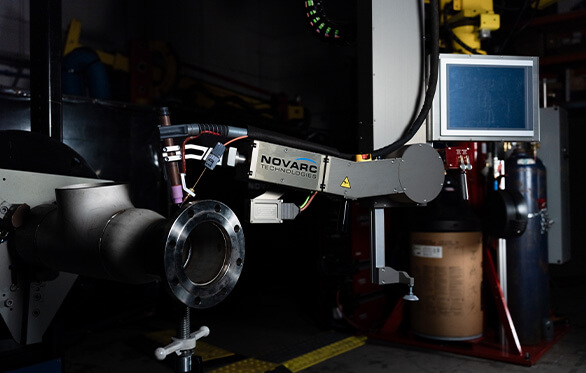
The SWR-TIPPTIG enhances TIG welding with the advanced TIPTIG system, boosting speed, precision, and productivity. It sets operations above the competition, pushing TIG welding to new heights.

Need Something Else?

Find many more smart solutions in MCAA’s Virtual Trade Show!

Speaking of Smart Solutions

Visit the Smart Solutions Case Studies area of our website to learn how other mechanical contractors found their win-win with cost-saving and productivity-enhancing applications from members of MCAA’s Manufacturer/Supplier Council.

This section of our website also includes tips and ideas to help your company save money and enhance your productivity. Don’t miss it!

Connect With Additional Manufacturer/Supplier Training

Save yourself time and let MCAA connect you to the latest Manufacturer/Supplier member’s training opportunities. Visit the Manufacturer/Supplier Training area of the Resource Center to get started. 

Optimizing Operations & Fan Experience Simultaneously featuring Johnson Controls

When the Milwaukee Brewers Baseball Club™ committed to making improvements to its ballpark, now known as American Family Field™, the organization looked to its long-term partner Johnson Controls to help provide fans with an outstanding experience while ensuring the ballpark operates at peak performance and efficiency. As a result, the team increased attendance significantly.

Looking for More Smart Solutions?

Visit the Smart Solutions Case Studies area of our website! You’ll see how other mechanical contractors found their win-win with productivity-enhancing and cost-saving applications from members of MCAA’s Manufacturer/Supplier Council.

Plus, you’ll find tips and ideas on other ways you and your company can save money and enhance your productivity.

Transforming Operations with Real-Time Visibility with Access Coins & P1 Construction, LLC

P1 Construction, LLC replaced its outdated legacy enterprise resource planning (ERP) system with Access Coins ERP and quickly started saving money, increasing productivity, and improving service delivery. Morgan Lassise, P1 Construction accounting manager, explained, “Access Coins has been perfect for us because it meets all the needs that we have as a contractor. We’re seeing increased job productivity across the board.”

Looking for More Smart Solutions?

Visit the Smart Solutions Case Studies area of our website! You’ll see how other mechanical contractors found their win-win with productivity-enhancing and cost-saving applications from members of MCAA’s Manufacturer/Supplier Council.

Plus, you’ll find tips and ideas on other ways you and your company can save money and enhance your productivity.

Unlock Industry Advancements at the MCAA26 Manufacturer/Supplier Council Exhibit

Join your colleagues for an engaging opportunity to explore the newest products, tools, and technologies transforming the mechanical contracting industry. Representatives from MCAA’s Manufacturer/Supplier Council will be onsite to showcase their solutions and share insights into how they’re helping contractors save time, reduce costs, minimize errors, and enhance overall efficiency.

Attendees will gain firsthand exposure to cutting-edge innovations that can give their businesses a competitive edge, while also learning practical strategies to boost productivity in both the office and the field. The exhibit provides a valuable opportunity to discover approaches that strengthen the bottom line and to build meaningful relationships with supplier and manufacturer executives who are active contributors to the MCAA community.

Register today to ensure your participation in the M/SC Exhibit at MCAA26.

Apply Now: MCAA/CNA Safety Excellence Awards Celebrate Innovation and Safety in Mechanical Contracting

MCAA and long-time safety partner CNA bring you the MCAA/CNA Safety Excellence Awards Program—one of the most prestigious recognitions in our industry. These annual awards honor MCAA member companies for outstanding safety programs and innovative safety initiatives, because nothing is more important than protecting the health and safety of our workforce. Take a moment to showcase your company’s success—apply today!

How to Qualify

To be eligible, submit your application by January 30, 2026, including:

  • A description of your 2025 safety and health program and why it deserves recognition.
  • Details of an innovation that helped you achieve exceptional safety performance during the year.

New Award Categories Reflect Industry Growth

New this year, we have updated the category sizes to keep up with the changing landscape of our industry. Companies will be grouped into five categories based on total hours worked, with one winner selected in each category:

  • Category 1: 0-200,000 hours
  • Category 2: 200,001-500,000 hours
  • Category 3: 500,001-1,000,000 hours
  • Category 4: 1,000,001-1,500,000 hours
  • Category 5: 1,500,001 + hours

 Winners will receive:

  • National recognition
  • A beautiful glass award to display proudly

Questions?

Contact Raffi Elchemmas (raffi@mcaa.org) for more information.

MCAA Government Affairs Update for the Week of December 15, 2025: The Latest Developments Impacting Our Industry

As part of its ongoing commitment to protecting your livelihood and setting the stage for a bright future, MCAA has secured the services of Longbow Public Policy Group to advise our MCAA Government Affairs Committee (GAC). GAC Chair, Jim Gaffney will be passing along information relative to our industry on a regular basis.

On Monday, December 15, 2025 MCAA Lobbying Firm, Longbow Public Policy Group provided the following information:

Trump Administration

  • MCAA plan trustees need to be aware and monitor implementation of an executive order President Trump signed last Thursday night to revise ERISA regulations governing ERISA plan fiduciary status and the obligations of such fiduciaries. Specifically, the order directs the Secretary of Labor to “revise all regulations and guidance regarding the fiduciary status of individuals who manage, or, like proxy advisors, advise those who manage, the rights appurtenant to shares held by plans covered under [ERISA],” including “proxy votes and corporate engagement, consistent with the policy of this order.” Among other things, the Secretary of Labor “shall consider whether these proposed revisions should include amendments to specify that any individual who has a relationship of trust and confidence with their client, including any proxy advisor, and who provides advice for a fee or other compensation, direct or indirect, with respect to the exercise of the rights appurtenant to shares held by ERISA plans, is an investment advice fiduciary under ERISA.” Generally, DOL is directed to strengthen ERISA fiduciary rules to increase fiduciaries’ transparency regarding their use of proxy advisors and ensure proxy advisors and plan managers act solely in the financial interest of American workers and retirees. The order also directs the Chairman of the SEC to rescind or revise all rules and regulations related to proxy-advisors that implicate DEI and ESG priorities, as well as rules related to shareholder proxy proposals that are inconsistent with the policies in the order. The order further directs the SEC to enforce anti-fraud provisions in securities laws against proxy advisors with respect to their voting recommendations, and to consider requiring proxy advisors to register as investment advisers and provide increased transparency on conflicts of interest. The SEC is also directed to assess whether proxy advisors serve as a vehicle for investment advisers to coordinate their voting decisions, and whether registered investment advisers breach their fiduciary duties by hiring proxy advisors to advise on non-pecuniary factors—such as DEI and ESG—in making investment decisions and subsequently following their recommendations. Finally, the order directs the Federal Trade Commission (FTC) and the Department of Justice (DOJ) to determine whether proxy advisors are engaged in unfair methods of competition or unfair or deceptive acts or practices and to review ongoing state antitrust investigations into proxy advisors for violations of federal antitrust law.
  • Last Thursday night, President Trump also signed an executive order to prevent states from regulating artificial intelligence (AI), including AI in the workplace, to ensure consistent, nationwide, federal regulation of this emerging technology instead of a patchwork of varying state laws the President fears could impede the deployment of AI technologies. The order directs the Attorney General to establish an AI Litigation Task Force to challenge unconstitutional, preempted, or otherwise unlawful state AI laws that harm innovation. The order directs the Secretary of Commerce to publish an evaluation of state AI laws that conflict with national AI policy priorities and withhold non-deployment Broadband Equity Access and Deployment (BEAD) funding from any state with such AI laws. Other agencies are directed to consider whether to make an absence of similar laws, or a policy of enforcement discretion with respect to any existing such laws, a condition of applicable discretionary grant programs. The order also instructs the FTC and Federal Communications Commission to take actions to limit the ability of states to force companies to embed DEI into their AI models. The order further calls for the development of a national AI legislative framework that would preempt state AI laws that stifle innovation.
  • As MCAA continues working with the Administration and allies in Congress on permitting reform, last Thursday, the Environmental Protection Agency’s (EPA) Office of Air and Radiation (OAR) launched the “Clean Air Act Resource for Data Centers” webpage to provide state and private sector entities developing data centers and artificial intelligence (AI) facilities with regulatory information, guidance, and technical tools for modeling, air quality permitting, and regulatory interpretations under the Clean Air Act. The webpage has three sections: (1) “Regulatory Resources,” providing information on rules that apply to stationary combustion turbines and stationary engines; (2) “Air Permitting Resources,” with EPA guidance documents, letters responding to permitting requests, and interpretations of permitting regulations; and (3) “Modeling Guidance Documents,” listing the agency’s preferred air quality models for use in the Prevention of Significant Deterioration (PSD) programs and providing modeling resources to assist with permit applications and showing compliance.
  • MCAA members who work on water treatment plants and oil well systems should be aware that last Wednesday, the Department of Homeland Security’s Cybersecurity and Infrastructure Security Agency (CISA), Federal Bureau of Investigation (FBI), Environmental Protection Agency (EPA), and several other federal agencies and international partners issued a new advisory urging immediate action by critical infrastructure organizations to mitigate the risk of being targeted by pro-Russia hacktivist groups. The agencies warn that these groups are “actively engaging in opportunistic, low-sophistication malicious cyber activity across multiple sectors,” and specifically note that targets include water treatment plants and oil well systems.
  • During oral arguments last Monday, the Supreme Court’s conservative majority sounded inclined to uphold President Trump’s firing of Democratic Federal Trade Commission Commissioner Rebecca Slaughter and potentially overturn Humphrey’s Executor, the 1935 precedent that shields leaders of independent federal agencies from being terminated by the President without cause. Conservative justices suggested that modern federal agencies wield far more power than when the precedent was created, while the court’s liberals warned that reversing Humphrey’s Executor would give the president “massive, unchecked” control over regulatory bodies across finance, labor, and public safety. The case will also impact President Trump’s firing of other independent agency heads, including the termination without cause of Democratic members of the National Labor Relations Board.

Congress

  • Last Thursday, the Senate voted 52-47 to adopt a block of 97 Trump Administration nominees using the new process to confirm nominees in blocks instead of individually. A final vote to confirm the nominees is expected early this week. The new package includes nominations of great interest to MCAA, including both James Murphy and Scott Mayer to be members of the National Labor Relations Board (NLRB) and Crystal Carey to be NLRB General Counsel. Once Murphy and Mayer are sworn in, the NLRB will regain its quorum and be able to start issuing opinions immediately. The package also includes: (1) Henry Mack to be DOL Assistant Secretary for Employment and Training (which oversees registered apprenticeship, workforce training, and DOL’s foreign guestworker programs); (2) Rosario Palmieri to be DOL Assistant Secretary for Policy; (3) former Rep. Anthony D’Esposito (R-NY) to be DOL Inspector General; (4) Jeffrey Hall to be EPA Assistant Secretary for Enforcement and Compliance; (5) Douglas Troutman to be EPA Assistant Administrator for Toxic Substances; (6) Mitch Graves, Jeff Hagood, Randall Jones, and Arthur Graham to be TVA Board Members; (7) James Percival to be General Counsel of the Department of Homeland Security; and (8) Edward Forst to be GSA Administrator.
  • Last week, the MCAA made considerable progress on its priority issue of permitting reform after successfully lobbying the House Rules Committee to schedule a markup of the MCAA-advocated Standardizing Permitting and Expediting Economic Development (SPEED) Act (H.R. 4776) for today, December 15, 2025. The SPEED Act represents sweeping permitting reform that will improve federal permitting of data centers and other large infrastructure projects and reduce litigation that impedes such projects. Ahead of expected floor action, the bill is facing opposition from both ends of the political spectrum. A handful of Republicans, including Reps. Jeff Van Drew (R-NJ), Chris Smith (R-NJ), and Andy Harris (R-MD), are urging President Trump to oppose the SPEED Act because they are afraid that permit protection language in the bill could inadvertently preserve offshore wind projects the Trump Administration is trying to kill. Democrats say their support hinges on limiting the Trump Administration’s ability to cancel wind, solar, and other renewable energy projects and Rep. Susie Lee (D-NV) offered an amendment to the SPEED Act requiring the Interior Department to treat all energy sources equally and prohibiting additional layers of review or the withholding, delaying, or reversing of state or local decisions for reasons not applied to oil, gas, or coal. A new National Petroleum Council report likewise warns the Trump Administration cannot advance fossil-fuel permitting reform while halting previously permitted renewable energy projects. Meanwhile, the House passed two modest permitting reform bills last week: (1) the Improving Interagency Coordination for Pipeline Reviews Act (H.R. 3668) by a vote of 213-184, which specifies timelines and procedures for FERC and other federal agencies to follow when conducting environmental reviews of natural gas pipelines and exempts interstate natural gas pipeline projects from the requirement to obtain water quality certifications from states under section 401 of the Clean Water Act (CWA); and (2) the Promoting Efficient Review for Modern Infrastructure Today (PERMIT) Act (H.R. 3898) by a vote of 221-205, which streamlines CWA permitting by redefining “navigable waters of the United States” to exclude waste treatment systems, prior converted cropland, groundwater, and other features determined to be excluded by the Army Corps of Engineers.
  • As the expiration of enhanced Affordable Care Act (ACA) subsidies looms at the end of this year, lawmakers remain far apart on how to address an issue that is top of mind for voters heading into the 2026 midterms. Last Thursday, the Senate held votes on two partisan health care bills that both required 60 votes to overcome procedural objections. First, the chamber voted 51-48 to reject a Republican proposal to let the enhanced ACA subsidies expire and replace them with new, time-limited health savings account payments for enrollees who switch to lower-cost, high-deductible bronze or catastrophic plans. Sen. Rand Paul (R-KY) was the only Republican to vote with Democrats against the bill. Senators also voted 51-48 to reject a Democratic proposal to extend the enhanced ACA subsidies for three years. GOP Sens. Susan Collins (ME), Josh Hawley (MO), Lisa Murkowski (AK), and Dan Sullivan (AK) joined Democrats in supporting this bill. The votes come as House Republican leadership said they will allow a vote next week on a GOP package of health care bills that does not include an extension of expiring enhanced ACA premium subsidies, but instead offers a package of policies ranging from expanded Health Savings Accounts and stricter oversight of pharmacy benefit managers to enhance “Price Transparency.” House GOP moderates are pushing a discharge petition to force a vote on a bill extending the enhanced ACA subsidies for two years, while some more conservative Republicans are focused on including new abortion-coverage restrictions—leaving the conference with no clear consensus on a path forward. The looming expiration of the subsidies comes as a new poll from Gallup shows that 57% of Americans approve of the ACA, while only 35% disapprove. Support varies depending on respondents’ political affiliation, with approval of the ACA ranging from 91% of Democrats to 63% of independents and only 15% of Republicans. Separately, a New York Federal Reserve survey this week found that U.S. households grew more pessimistic about their current and near-term financial situations last month, with many concerned about increased medical expenses, which jumped 10.1%—the highest in more than a decade.
  • Last Wednesday, the House voted 312-112 to pass the 3,100-page compromise text of the fiscal year (FY) 2026 National Defense Authorization Act (NDAA). Of interest for the MCAA, the final bill authorizes $26 billion for shipbuilding, including for Virginia class attack submarines and authorizes funding to build additional Coast Guard cutters. Also of interest to MCAA, the final bill excluded Sen. Elizabeth Warren’s (D-MA) “Right-to-Repair” language supported by the Trump Pentagon to ensure the U.S. military retains access to data and parts necessary to repair its weapons systems. The final bill text also excluded the bipartisan Road to Housing Act that was in the Senate version of the NDAA to speed construction of multifamily housing and to address housing affordability.

Around the Country

  • As the MCAA continues to engage the Labor Department on our priority issue of preventing the misclassification of construction workers as independent contractors, we learned last Wednesday that the Labor Department’s Wage and Hour Division recovered $596,000 in back wages and fringe benefits for 31 workers after finding that Maryland subcontractor J. Solano HVAC ran a kickback scheme on two D.C.-funded affordable housing projects. Investigators determined the company paid workers the required Davis-Bacon prevailing wage by check but then forced them to return any amount above $30/hour, while also misclassifying some workers as lower-skilled laborers to avoid paying higher hourly rates for HVAC technicians and plumbers. Because the violations were deemed willful, DOL debarred the company and its owner from federal contracting for three years.
  • MCAA members operating in Minnesota should be aware that last Tuesday, the General Services Administration (GSA) awarded a $105 million Design-Build Construction contract to McGough Construction for design and construction of the Land Port of Entry Project in Grand Portage, MN, located on the Grand Portage Indian Reservation and serving passenger and commercial traffic between northeastern Minnesota and Ontario, Canada. Construction is expected to begin next summer, and the project will replace 1960s-era facilities across the 10.4-acre port with new, modernized buildings designed to improve security, efficiency, and processing capacity. The project will also add lanes—including a wider commercial truck lane—to reduce congestion and expand trade. GSA said that it expects substantial completion of the project by fall/winter 2029. Additional information about the project is available here.

Matching Material to Application for Better Results: Advice from NIBCO INC.

In commercial plumbing and mechanical systems, material selection is far more than a matter of preference or budget—it directly impacts system performance, longevity, and reliability. Standards offer a framework, but truly effective practice requires that you match the materials to the specific demands of the application.

Looking for More Smart Solutions?

Visit the Smart Solutions Case Studies area of our website! You’ll see how other mechanical contractors found their win-win with productivity-enhancing and cost-saving applications from members of MCAA’s Manufacturer/Supplier Council.

Plus, you’ll find tips and ideas on other ways you and your company can save money and enhance your productivity.

Connect with Student Chapters at MCAA26

Did you know that over 35 student chapters will be represented at MCAA26? We know everyone has a busy convention schedule, so MCAA is making it easier for members to connect with students at the Student Chapter Connection Corner.  

This welcoming space is ideal for informal contractor-student employment conversations, as well as student peer-to-peer meetups for chapters interested in sharing ideas and best practices. 

The Student Chapter Connection Corner will be located in the Grand Saguaro Ballroom Foyer and students will be available to connect at the following times: 

  • Sunday, March 15, 9:00 a.m. – 3:00 p.m. 
  • Monday, March 16, 7:00 a.m. – 3:00 p.m. 
  • Tuesday, March 17, 10:00 a.m. – 3:00 p.m. 
  • Wednesday, March 18, 9:00 a.m. – 3:00 p.m. 
  • Thursday, March 19, 7:00 a.m. – 9:00 a.m. 

Register today to find your next intern – or future employee – at MCAA26! 

Foundations of Field Leadership Online: Registration Deadline is December 19th!

January 8 – February 26, 2026 | Foundations of Field Leadership Course 11 – CLOSED
January 13 – March 3, 2026 | Foundations of Field Leadership Course 12

If you want to fast-track your new and aspiring field leaders in 2026, MCAA has just the program! Foundations of Field Leadership begins in January: once a week for 8 weeks, students spend 90 minutes online with an experienced field leader, who will walk them through best practices and practical strategies of running work and running a crew.

From Planning to Leadership, from Documentation to Safety: our instructors break down the ‘why’ and the ‘how’ of things that every foreman must understand to be successful. The course itself is made up of weekly online lectures with real-time student interaction, quizzes, and short video assignments. Here’s what our past grads had to say about their experience in Foundations of Field Leadership:  

  • “Very easy to listen to the instructor, very knowledgeable and personable.”
  • “I like learning from someone with a lot of experience and learning how to do the job more efficiently.”
  • “I appreciated [the instructor’s] content. I’ve been in the trade for 25 years and have only been running work for the last 3 years. I’ve either been in or around all the situations [the instructors] spoke about and appreciated his insight. Great ways to handle things.”
  • “The information was delivered clearly and was easy to understand. It gave everyone the chance to apply their thoughts and comments.”
  • “[I appreciated the instructor] acknowledging the fact that being in this class is a step forward in my career, and it feels good to know my hard work and dedication hasn’t gone unnoticed by my company.”

Visit the FFL course webpage to learn more about this exciting opportunity for new and future field leaders, and to sign your people up today!