NCPWB Technical Bulletin: Microbiologically Influenced Corrosion (MIC)
What is Microbiologically Influenced Corrosion (MIC) and why do contractors need to know anything about it? Well, it turns out that MIC can negatively affect your profits.
On occasion we get questions from our members who would like to use backing flux in lieu of purging when making welds on stainless steel or other corrosion resistant materials. This bulletin describes an experiment conducted by NCPWB Consultant Walter Sperko where he had a colleague make stainless steel butt welds without any protection of the root of the weld, with inert gas backing, with backing flux and with flux-coated wire.
When reviewing a Welding Procedure Specification (WPS) or a welder qualification record, the term “backing” frequently appears. In some cases, backing is required, while in others, it is optional. Backing can take various forms, including metal, non-fusing metal, nonmetallic materials, or even weld metal. But what exactly is “backing,” and why is it important in welding?
The E6010 electrode is a wire encased in cellulose held together with salts and minerals. These electrodes penetrate better than low-hydrogen electrodes like E7018 when making root passes, making it easier to make a good root pass. However, E6010 introduces hydrogen into the weld creating a risk of cracking, and this article shows when its use should be limited.
Piping codes are standard industry practice, and failure to agree on the one that applies to your work can result in ugly disputes with customers. Customer specifications can have inspection requirements that can result in repairs to welds that you did not plan for. Welders can make welds that put your business at risk. This article highlights what you can do to avoid these risks.
While there is a lot of buzz about modern waveform controlled power sources and how they make it easier for a welder to make the root pass, the basics of MIG welding have not changed. This article describes the technical aspects of GMAW, explains how the metal gets from the wire to the workpiece (transfer modes), and highlights what contractors need to pay attention to when bringing the process into their shop or field fabrication site.
The 37-1/2°± 2-1/2° bevel is the normal bevel angle to find on piping fittings and flanges and in many specifications and standards. Where did such a weird angle originate?
This bulletin explains how the National Certified Pipe Welding Bureau (NCPWB) Welding Procedure Specifications (WPSs) differ from the American Welding Society (AWS) Standard Welding Procedures in both application and adoption.NCPWB WPSs and AWS Standard Welding Procedures differ in both application and adoption.
There is occasional confusion among NCPWB members who use orbital pipe and tube welding machines when it comes to determining just what is required to qualify a welding operator and how to properly complete the QW-484 form for welding operators. This bulletin clarifies the difference between a welder and a welding operator and provides sample welder qualification test records for welding operators using automatic and machine welding.
This bulletin explains how to protect welders from exposure to welding fumes and minimize health risks.
The most misleading statement in the welding industry is that a welder is qualified to follow a Welding Procedure Specification (WPS). A welder is qualified to use a welding process, not a WPS. This article explains what welders are allowed to weld in production based on the test conditions.
How to determine the number of test coupons required to meet the minimum weld length for radiographic examination under ASME Section IX.
P-number is a numbering system used by ASME for grouping materials of similar weldability so that Code users don’t have to qualify every material that is being welded.
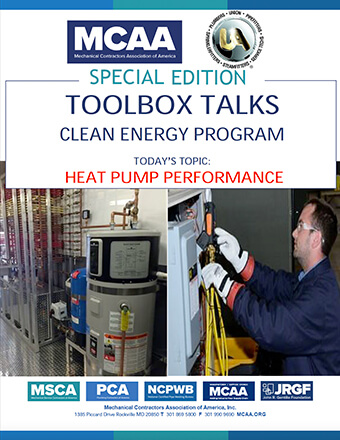
Together with the United Association (UA), MCAA is excited to bring you a new Clean Energy Heat Pump Performance Program. Heat pumps provide clean energy that can reduce or eliminate carbon dioxide from energy sources, thus operating more efficiently. Numerous state and federal financial incentives make heat pumps beneficial to both building owners and contractors. Signatory contractors and UA members are uniquely qualified to get trained and perform the work to reduce the carbon footprint for any state or city. Email Raffi Elchemmas (raffi@mcaa.org) or Robert Vilches (rvilches@uanet.org) to sign up.
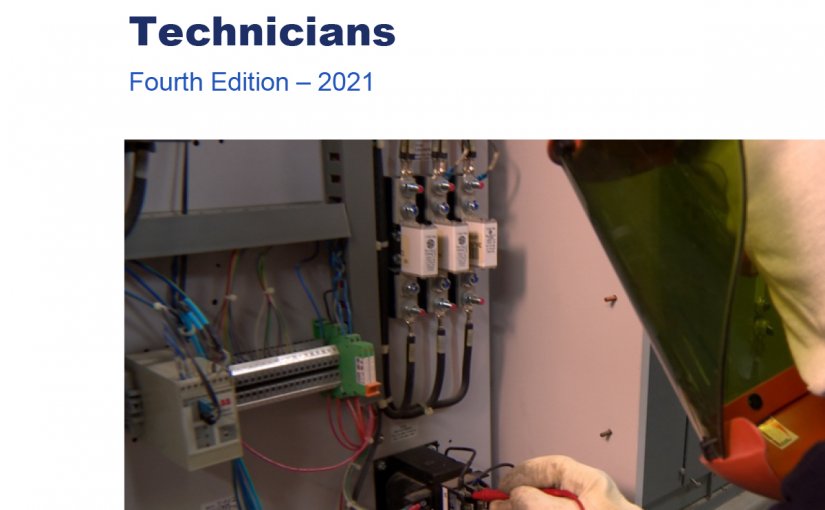
This quick reference tool provides critical information on 84 safety and health topics that are specific to work performed by mechanical service technicians, including information on the newest and most frequently used refrigerants, substantive changes to NFPA 70E, and new information on how to properly administer CPR.
A contractor has liability when contracts specify meeting ASME B31 Codes. When it comes to welding procedures and welder qualification, meeting those requirements can be challenging. Those responsibilities can be met easily as members of the NCPWB by following a few simple rules that will be explained during this presentation.
When welding stainless steel and nickel alloy piping using an open root or consumable insert, the root side of the joint (i.e., the inside surface of the pipe at a weld) must be protected from the oxygen in the atmosphere, otherwise the liquid weld metal will oxidize badly creating a surface that is not only discolored but is also quite rough. This roughness and discoloration will reduce the corrosion resistance of the metal at the weld. In this webinar you will learn what is acceptable level of discoloration of the root side of the stainless-steel pipe weld and provides general guidance on the level of root surface discoloration that can be tolerated for some service conditions.
There are key aspects about pipe welding that project managers and supervisors must understand in order to be sure that welds their company makes are suitable for service and meet contract and code requirements. Despite the idea that codes are difficult to meet, when properly understood and followed, they can protect a contractor from unreasonable demands by owners and their engineers. Knowing what codes cover allows managers to identify unusual and costly requirements in customer specifications. Understanding what goes on in assembling and welding pipe joints illustrates the importance of performing inspections at critical steps. Codes impose radiography or ultrasonic examinations and customers frequently add additional requirements and knowing how to manage those requirements on a project can make or break a job.