NCPWB Technical Bulletin: Microbiologically Influenced Corrosion (MIC)
What is Microbiologically Influenced Corrosion (MIC) and why do contractors need to know anything about it? Well, it turns out that MIC can negatively affect your profits.
On occasion we get questions from our members who would like to use backing flux in lieu of purging when making welds on stainless steel or other corrosion resistant materials. This bulletin describes an experiment conducted by NCPWB Consultant Walter Sperko where he had a colleague make stainless steel butt welds without any protection of the root of the weld, with inert gas backing, with backing flux and with flux-coated wire.
When reviewing a Welding Procedure Specification (WPS) or a welder qualification record, the term “backing” frequently appears. In some cases, backing is required, while in others, it is optional. Backing can take various forms, including metal, non-fusing metal, nonmetallic materials, or even weld metal. But what exactly is “backing,” and why is it important in welding?
Understanding the implications of the Inflation Reduction Act and its impact on pricing jobs for installing heat pumps or heat pump water heaters can be daunting. However, a new resource from ENERGY STAR aims to simplify this process, specifically tailored for selling and installing Air Source Heat Pumps, Heat Pump Water Heaters, and Electric Panel Upgrades. It’s crucial for both contractors and property owners to grasp these credits, as they can cover up to 30% of project costs.
Two prevalent misconceptions revolve around the effectiveness of heat pumps in colder climates and their serviceability. To address these misgivings and better equip professionals for customer discussions, MSCA contractors and ENERGY STAR have developed a concise reference guide. This resource not only tackles these challenges head-on but also aids in preparing individuals for productive conversations with clients who hold these perceptions.
Together with the United Association (UA), MCAA is excited to bring you a new Clean Energy Heat Pump Performance Program. Heat pumps provide clean energy that can reduce or eliminate carbon dioxide from energy sources, thus operating more efficiently. Numerous state and federal financial incentives make heat pumps beneficial to both building owners and contractors. Signatory contractors and UA members are uniquely qualified to get trained and perform the work to reduce the carbon footprint for any state or city. Email Raffi Elchemmas (raffi@mcaa.org) or Robert Vilches (rvilches@uanet.org) to sign up.
Small and medium contractors have some advantages when it comes to both innovation and fabrication. Innovation is far easier to implement when there are fewer people to train on a new process. Fabrication can be highly productive in smaller spaces that require less overhead.
On Thursday, February 11, 2021, North Mechanical Contractors, headquartered in Indianapolis, Indiana shared some insights on how they drive an amazing amount of productivity through innovation. The presentation, led by North’s VDC and Technology Manager Trent Leinenbach and Tole Burnett, the company’s Manufacturing Manager, demonstrated the process, software and hardware that allow them to approach fabrication from a manufacturing mindset.
Their presentation largely featured a software integration with GTP Stratus that allowed them to connect their VDC and BIM department with the fabrication shop and the field. The software not only assists in their organization, process, purchasing and scheduling, it can be used to drive manufacturing equipment more efficiently. One of the many processes North shared in the video demonstration was how the software provides automated cut lists that can minimize waste by driving a Tigerstop to automate pipe lengths before cutting them automatically.
It also allows computer workstations at fabrication stations access to more information. This includes 3D models that can be rotated and zoomed with dimensions and hidden systems available to be seen.

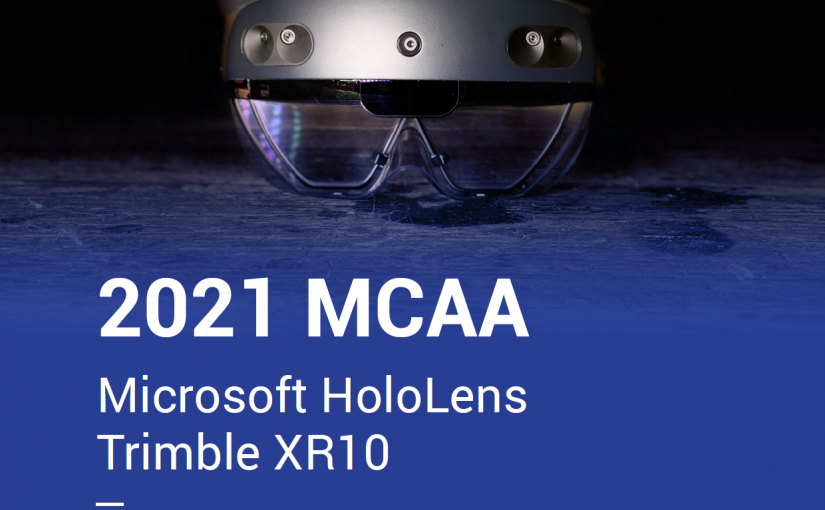
Since its release in 2016, the Microsoft HoloLens 1 has proven an effective tool for contractors with advanced BIM/VDC operations when combined with the right software. Microsoft released an improved version of the HoloLens in late 2019 and partnered with Trimble to develop the Trimble XR10 model specifically for the construction industry. The Trimble XR10 integrates the Microsoft HoloLens 2 with an industry-standard hard hat and rebalances the design to accommodate construction site functionality. The MCAA Innovative Technologies Committee’s new report evaluates the Trimble XR10 and shares case studies of its use in the field. On February 4, MCAA’s Director of Innovative Technologies, Sean McGuire, hosted the report’s principal author, James Benham from JBKnowledge, for an in-depth webinar. They zeroed in on some of the key features and spoke about how contractors are already using the XR10 and testing it with new use cases. An earlier, related report is available here.
The best way to understand your company’s technology challenges is to understand your processes. This workflow tool helps you understand and document your company’s entire project management flow, including the application of fabrication, BIM and Virtual Design and Construction (VDC) processes. It identifies in detail the potential implementation of VDC throughout each phase of the project lifecycle and details the team members involved and their specific responsibilities for each phase of the construction process. (Note: MCAA members will need to set up a free Lucidchart account and create a copy of the template to customize the flowchart for their company’s processes.)
The use of BIM and related technologies and processes that leverage data from models is delivering meaningful impact to mechanical and HVAC contractors on a wide variety of measures, including cost and schedule improvements, enhanced productivity, better collaboration between stakeholders and better worker safety. This research report quantifies other benefits to users and the challenges related to leveraging BIM to increase industry understanding of which factors will most effectively drive growth and expand future use.
Improved productivity and quality are among the benefits driving interest in, and use of, prefabrication and modular construction today. This research report quantifies other benefits to users and the challenges related to each to increase industry understanding of which factors will most effectively drive growth and expand future use.